Industry: Chemical Processing
Scope: Intercooler Knockout (KO) Drum
Project Details: Engineering Study, Design, Implementation
Overview
A second-stage intercooler knockout drum was experiencing liquid carryover due to undersizing and unfavorable geometry. Conventional approaches recommended vessel replacement and piping modifications.
Koch-Glitsch used Computational Fluid Dynamics (CFD) to evaluate a retrofit solution within the existing vessel. The result was eliminated carryover, improved performance, and avoided costly replacement.
Challenge
The existing vessel presented several constraints:
- Undersized for current flow rates
- Short inlet-to-outlet length limiting separation performance
- Non-ideal geometry causing under-use of the media
- Liquid carryover impacting downstream equipment
While vessel replacement was the typical recommendation, it introduced significant cost and complexity. The key question was whether the existing vessel could be reused with confidence.
Approach
Koch-Glitsch evaluated multiple retrofit concepts using iterative CFD modeling to understand internal flow behavior and separation performance.
The analysis focused on:
- Vapor distribution
- Local C-factors
- Entrainment risk and interaction with vessel geometry
CFD also enabled detailed evaluation of vapor distribution. Initial analysis indicated a relative distribution of approximately 20%, which was acceptable but required further refinement to avoid localized vapor blocking and liquid drainage interference.
This level of insight allowed potential performance risks to be identified and addressed prior to finalizing the design.
Solution
Based on CFD results, Koch-Glitsch developed a retrofit solution tailored to the vessel’s constraints.
The final design included:
- A purpose-built inlet device to radially redistribute vapor and reduce direct impingement
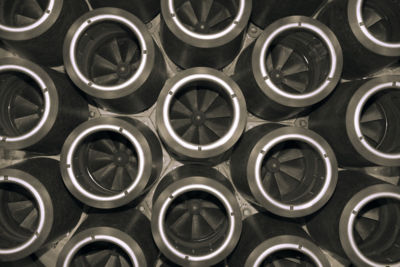
- A VORSOMAX® cyclone mist eliminator to provide effective droplet capture within the limited vessel footprint
- An internal drainage system designed to prevent flow interference and support proper liquid removal
The internal drainage design was critical in avoiding flow shadowing and enabling vapor redistribution across the vessel cross-section. This integrated approach enabled effective separation within the constrained geometry.
Results & Value
Following implementation:
- Liquid carryover was eliminated
- No further operational issues were reported
- The solution was successfully replicated in two additional vessels with similar performance
By applying phase separations expertise and flow characterization by CFD, Koch-Glitsch helped the customer:
- Avoided vessel replacement and associated costs that exceeded 2X the cost of the internals
- Improve performance within existing equipment
- Implement a repeatable retrofit approach
Why CFD Matters
CFD provided visibility into vapor distribution, C-factor variation, and entrainment risk that is not accessible through conventional design methods. When combined with Koch-Glitsch's phase separation expertise, it enables validated retrofit solutions in constrained geometries.